

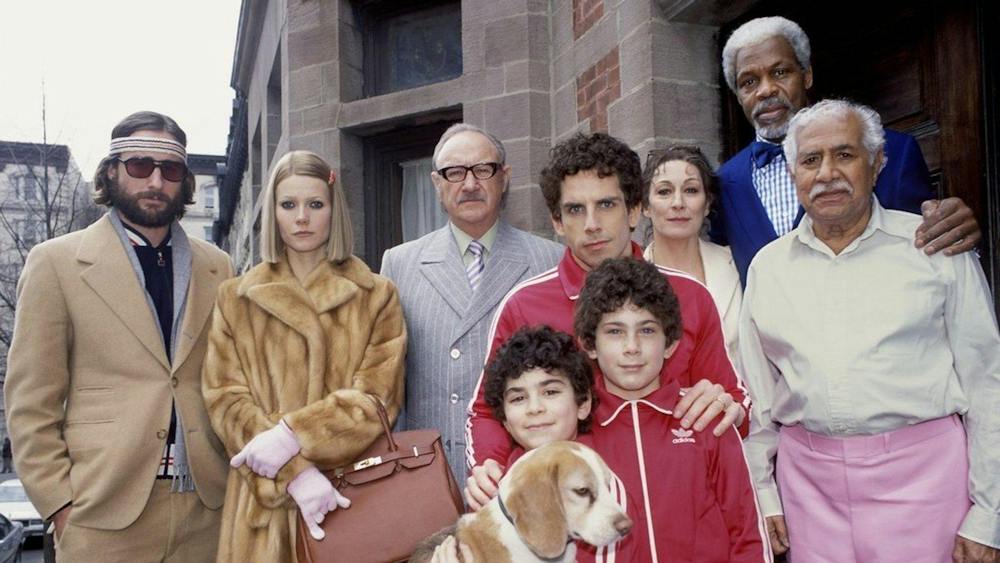

“The Royal Tenenbaums” is an odd film. It is the first true Wes Anderson (no relation) feature– technically, “Bottle Rocket” and “Rushmore” preceded it, but “Tenenbaums” was the inauguration of his idiosyncratic style that has saturated his work for the last quarter-century and counting.
Anyone who has seen a Wes Anderson picture knows what I am referring to: the characters that exist as walking bundles of quirks, the formalist production design that evokes dollhouses and the self-consciously witty dialogue. For some, this style is creative genius. For me, an Anderson film usually plays like a family-friendly comedian. It gives you exactly what you came for, without a shred more to challenge you or hook your interest too much.
“The Royal Tenenbaums” is, admittedly, not that tidy. It is also not that satisfying.
The movie begins with the Wes Anderson-typical narration explaining the precocious Tenenbaum children: business-minded Chas, prolific playwright Margot, and tennis star Richie. With their neighborhood friend Eli Cash and their parents, Royal and Etheline, the Tenenbaum family prospered in their New York mansion until they did not.
Royal and Etheline separate, and over the years the family drifts apart, each Tenenbaum child slowly but surely devolving into shadows of their former selves. Two decades later, Royal Tenenbaum is forcefully expelled from his longtime residence in a hotel room and hatches a plot to see his family and stop his old wife from marrying again.
Anderson’s recent films have dealt with notably dramatic goings-on, from alien visits (“Asteroid City”) to worldwide political intrigue (“The Phoenician Scheme”), but they have a frothiness that keeps the tone jaunty no matter what happens. “The Royal Tenenbaums,” by contrast, is strangely dour and unpleasant. One foot planted in Anderson whimsyland and the other in sad drama.
The family member dynamics that form the cornerstone of this film are sometimes amusing, too often uncomfortable. Take Chas and Royal Tenenbaum. Chas is a caricature of a man, perpetually paranoid after the death of his wife in a plane crash. He screams at his children in the dead of night to wake them up for a fire drill and he carries that same vigilance into his interactions with the other Tenenbaums.
Ben Stiller plays Chas with the comic force exhibited by most Anderson cast members, but most of his scenes just read as uncomfortable. The invasive control he exercises over his children and his refusal to treat his father with anything but contempt does not mesh with the lighthearted tone the movie wants to have. It is not endearing that they can not get through a dinner conversation without Chas starting arguments over nothing; it is palpably tense.
Then there is the even more baffling case of Richie and Margot Tenenbaum. Although Margot was adopted, they were raised together from the age of two. For all intents and purposes, they are siblings. Yet Richie falls in love with Margot, who already has a husband and an affair partner.
“The Royal Tenenbaums” does not give us any hints as to how we are supposed to take this, as an insane dark comedy scandal or as a genuine emotional conflict. There are lines about the oddness of falling in love with your sister, but just as often the movie repeatedly clarifies that they are only adopted siblings, as if that makes it better. Is it funny? Is it tragic? Is it both? I just found it gross.
“The Royal Tenenbaums” is beset by this general feeling of uneasiness, cascading throughout other plot detours like a microaggressive confrontation between Royal and Etheline’s African American suitor, and the blithe treatment of, to avoid spoilers, a mental health crisis. The cast navigate this the best they can, all fully committed to Anderson's unique filmmaking.
My favorite character was probably Margot (Gwyneth Paltrow, for once glamor-less), a recluse equal parts deadpan and scathing. Even as a child, she sports eyeliner straight from Hot Topic circa the early 2000s. The greatest performance is unquestionably Gene Hackman as Royal, playing exactly the kind of endearing straight man that can sustain this movie even at its most disconcerting.
Anderson seems to have abandoned this archetype in subsequent work, but it’s so incredibly refreshing to watch one of his movies where there is someone recognizably human. Perhaps if he had populated “The Royal Tenenbaums” with more characters like Royal instead of drugged-up authors in cowboy hats and larger-than-life former child prodigies, the movie would be more cohesive.
Ultimately, despite all I have said, “The Royal Tenenbaums” will (and has) satisfied Wes Anderson fans. His signature would refine in his later work, but there is an appeal to seeing them at ground zero, their most raw and rough. A sizable number of people will walk into “Royal Tenenbaums” and laugh, and cry, and declare it a masterpiece. I am not one of those people.
Sure, I can appreciate the artistry of the Andersonian style. Yet, to me, it feels designed to distract from the fact that the Tenenbaum family, between the borderline child abuse, mishandling of mental health, pseudo-incest, covert racism and infidelity, is altogether vile.
“The Royal Tenenbaums” will screen at the Little Art Theater on Friday, October 2 as part of the Yellow Springs Film Festival.


