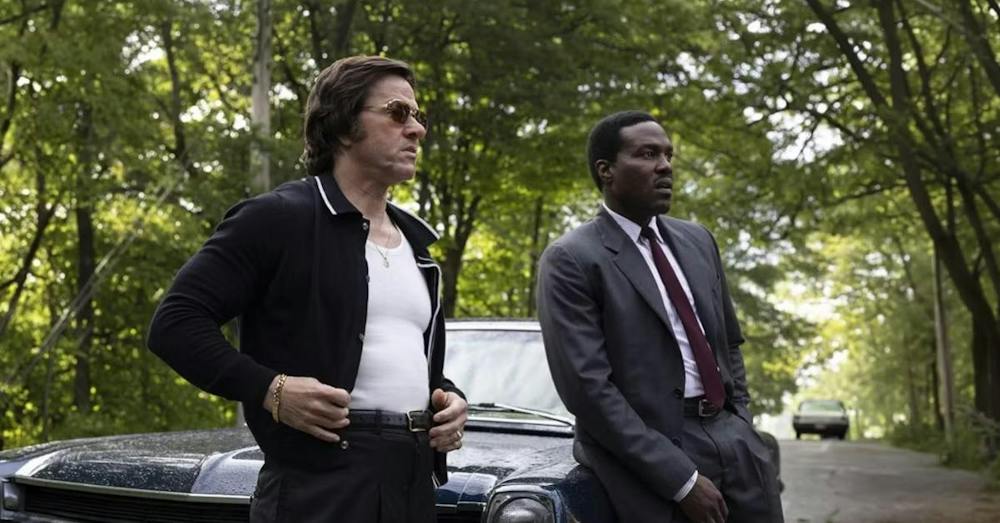

A black FBI Agent and a Mafia hitman walk into a Deep South conspiracy. The result is “By Any Means,” a crime thriller that is by turns fun and engaging, but a bit underthought.
As you probably noticed, it is quite a pitch, and the opening sequences seem to get the ball rolling in the right direction. After a grueling torture sequence in which Mafioso Gregory Scarpa (Mark Wahlberg) beats the locations of dead bodies out of a KKK member, we jump forward in time to Agent Wayne Strider (Yahya Abdul-Mateen II). Restless from being treated as a nuisance rather than an asset, Strider springs into action when an NAACP leader is murdered by the Klan.
Unfortunately for him, most people in the local Mississippi area are struck mute with fear of violent retribution for snitching. The ones that can talk are not, to understate things, too keen on African-Americans or the FBI. To push the investigation forward, his higher-ups send Scarpa, a mob member and connoisseur of “enhanced interrogation techniques” whose previous antics helped the Feds crack a previous murder case. It is Scarpa and Strider vs. the KKK and the many, many people complacent with them.
“By Any Means” does a lot of things right. It is at its best when it feels like an FBI movie and a mafia movie crashing together, interrogating each other and their different modes of operation. Wahlberg has a lot of fun as the cigarette-toting Scarpa, but he is just as plausible as an unrelenting sociopath in the film’s torture scenes. His chemistry with the straight-laced Abdul-Mateen II is a highlight, Strider calling out his ignorance of black history about as casually as Scarpa dispatches a racist cop.
If you are looking for a fun crime movie, “By Any Means” delivers the goods. The admittedly familiar plot beats and less-than-confident direction are given enough spark by the dynamic duo at the center to make it worth it, to say nothing of some unexpected developments and hard-hitting emotional moments. But when you look at what the movie’s trying to say beneath the wisecracks, things begin to stumble.
The biggest difference between Strider and Scarpa is not their professions, but their approaches to adversity. Strider’s character conflict throughout “By Any Means” is his repeated refusal to stand up for himself in the face of blatant racism and oppression. Through exposure and embracing of Scarpa’s extreme methods, he learns to fight his own. Here is the problem: Strider’s complacency to racist systems is framed as cowardice rather than a survival instinct.
Fundamentally, he cannot simply fight back in rural 1960s Mississippi. His race ensures that, at all times, he has to treat white oppressors better than they treat him, or he runs the risk of endangering his life. Our system is one that does not take kindly to people of color standing up for themselves against cops or other authority figures. In a world where holding a candy bar is enough grounds to shoot an innocent teenager, black people do not get the privilege of retaliative violence.
Scarpa is painted as a character foil who doesn’t take anything from anyone and repeatedly chastises Strider for his complacency. “By Any Means” thinks that, to some degree, Scarpa’s right, but the comparison is faulty for the simple fact that Scarpa is white and Strider is black, magnified by the Deep South setting and the 60s time period. The same rules do not apply to them.
Now, yes, it is immensely satisfying watching Strider turn the tables on a group of terrorists who try to murder him and his wife. But that is him going above and beyond, and shouldn’t be framed as a baseline expectation. Scenes like him being beaten by gun-toting racists, Strider curled into a ball, are not him acting cowardly. It is the reality of living in a corrupt system.
Further problems arise when this character conflict intersects with the torture element. Credit where credits’ due: there is a surprising amount of nuance and moral ambiguity in how “By Any Means” portrays torture as an interrogation method. In most cases, Scarpa is viewed as going too far into cruelty, with the climactic sequence framed as gut-wrenching and disgusting.
I get the impression that this being the ultimate way to solve problems is not supposed to sit entirely easy–is it alright to assault, maim, and disfigure people if it serves the greater good? Is Scarpa ultimately an agent for good, or is he just perpetuating an endless cycle of violence? Does Strider’s eventual acceptance of these methods represent growth or his hardening into an “eye for an eye” attitude?
Yet, the entire premise of this conclusion is undermined because torture does not work as interrogation. Numerous studies have proven as much. I am all for artistic liberties in media, but there is a difference between that and perpetuating falsehoods. In actuality, Scarpa’s brutality has no benefit, and by endorsing them Strider would make for a worse agent not just on moral, but practical grounds.
The most disappointing part is that a film which plays into the ineffectiveness of torture that is still utilized by our government would be fascinating and give something new for “By Any Means” to say. Our employment of “enhanced interrogation techniques,” in the opinion of this reviewer, damaged countless people and accomplished nothing. Surely that could marry into the themes of the government’s negligent apathy towards people of colour. And yet, “By Any Means” takes the easy way out, accepting the standard Hollywood narrative that torture works, instead of breaking past the cliches for some truly intriguing ideas.
“By Any Means” is good for what it is—entertaining, well-acted, somewhat unexpected in places. But it is a decent movie that had the potential for greatness. There was room to more honestly grapple with the difficult questions it raises, about operating under unjust systems and how we should treat horrible people, and how we draw the lines between justice and retribution. But without probing those depths, it only works as a romp with an edge, one that leaves the mind not long after exiting the theater.