

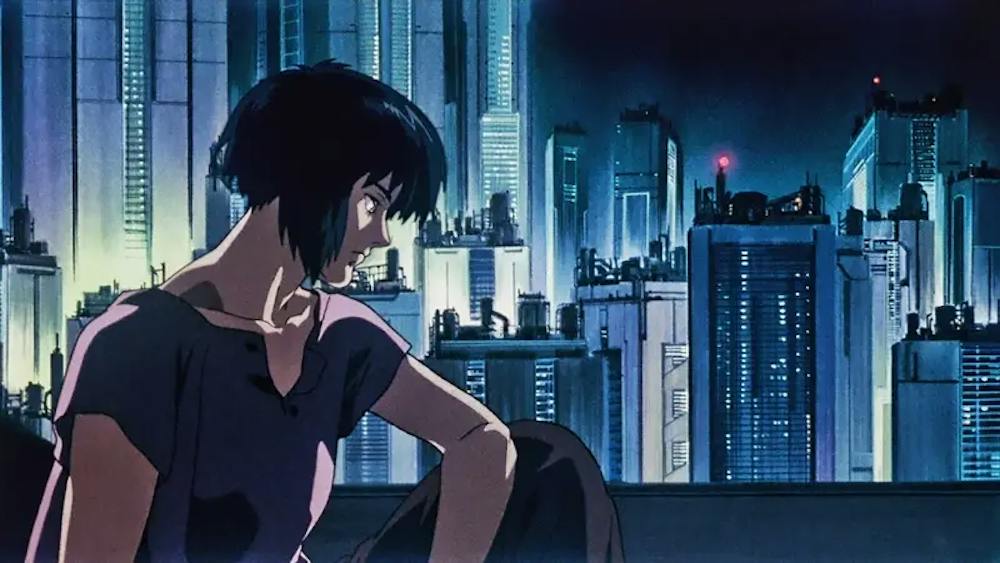

For better or for worse, “Ghost in the Shell” is the quintessential anime sci-fi movie.
All the expected pieces are here–great animation, dense and existential plotting, 90s-style techno effects and plenty of visceral fights. If it is slightly less than the sum of its parts, it is still a fun ride, one that continues to resonate 30 years after release.
In Japan circa 2029, technology has advanced to such an extent that human bodies can be created and perfect: not just flesh and bones, but cybernetic “enhancements” for them to realize their maximum potential. “Ghost in the Shell” follows Motoko Kusanagi, a female assassin who has opted to place her mind into one of these bodies. She is forced to take on the mysterious Puppet Master, a fully artificial being who has the ability to “hack” cyborgs for his own plans. What starts as a simple assignment for Motoko spirals into something far more troubling as she begins to question the lines between man and machine.
One important thing to keep in mind: “Ghost in the Shell” is a simple movie in a complicated movie costume. The opening scenes pile on so much exposition and terminology that you almost dig out the pencil and paper from your backpack. However, the meat of the action is pretty straightforward: bad guy is on the loose, Motoko must stop him, bad guy has more going on than it seems. Obviously, there is a lot more to it than that, but at no point will you feel left out if you are not following the finer details. For a movie that moves at such a brusque pace, this is both challenging to pull off and commendable.
“Ghost in the Shell” owes a debt to many sci-fi movies of its time and is not shy about it. “Blade Runner” and its deconstruction of what it means to be human might be the most obvious source (both films even feature moving scenes of a cyborg realizing their cherished memories are fake).
With that said, it never feels overly derivative, and the film synthesizes them enough to inspire a whole new roster of classics. A lot of the thematic ideas being explored–where the human begins and the cyborg ends, what if an android wants to be human–are not new, but “Ghost in the Shell” imbues them with its own unique gungy sensibilities; the Puppet Master is hosted in a woman’s cybernetic body with mangled metal wiring protruding from the arm and leg sockets. It is this level of creativity and willingness to go for broke that led to the film being as iconic as it is. If the code-like green text in the opening did not clue you in, “Cyberpunk 2077,” “The Matrix” and a whole bunch of other media franchises would be totally unrecognizable without “Ghost in the Shell.”
The film was released in U.S. theaters 30 years ago, and undoubtedly some of it reads as dated. Motoko just so happens to have to get completely naked for a quirk of her job, which I am sure was an extremely necessary detail and not at all thought up so that male audience members get to ogle women. But in other senses, the 90s-ness of it all is rather charming.
Only a movie from that era could lean so heavily into, for lack of a better word, “edginess,” from the gloomy yet imposing city to the startlingly bloody visuals (at one point, someone’s head honest-to-God bursts open). Motoko is refreshingly jaded about her position in the world, prioritizing her mission well above the comfort of her comrades. In a lesser movie, such an attitude would seem grating and facile, but “Ghost in the Shell” has the world to prove it is totally appropriate–and fascinating.
Overall, we have a compelling mix of interesting characters, great visuals, wince-worthy action and plenty of thought-provoking commentary. Yeah, it bites off more than it can chew for a runtime below 80 minutes. Ultimately, that is part of the fun. There is no doubt in my mind that “Ghost in the Shell” has more layers to probe that rewatches will uncover. And with a world this fleshed-out and aesthetic this strong, it is worth the time.
“Ghost in the Shell” is now playing at Regal at Fairfield Commons from Sept. 18 to Sept. 24.


