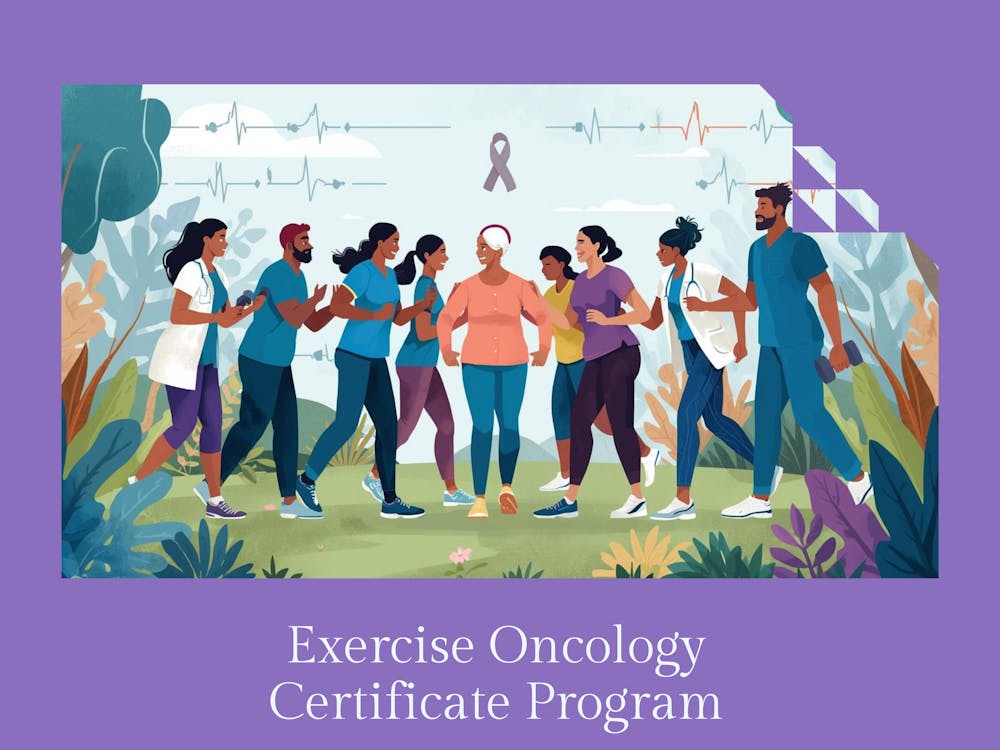
Launched in Fall 2024, Wright State University's Exercise Oncology Certification for undergraduate and graduate students in the College of Health and Exercise Science reshapes how WSU and future oncology students approach the movement of cancer research.
Exercise oncology certification
The Exercise Oncology Certification program is run through the Department of Kinesiology and Health at WSU. The program takes a patient-first approach to cancer treatments. The end goal of the program is to effectively explain how to create an exercise plan for those who are being treated for cancer. Additionally, the program aims to have students trained in the workforce, as this is a rapidly growing treatment option for patients.
The program is spearheaded by Dr. Karen Wonders, Ph.D., a WSU faculty member. Dr. Wonders is the founder of the Maple Tree Cancer Alliance, who aims to improve the quality of life in cancer patients. In 2025, Dr. Wonders was honored as a part of WDTN-TV’s “Remarkable Women of Dayton” series for her work in the cancer field. Dr. Wonders and the team at Maple Tree are big supporters of the Exercise Oncology field, saying the evidence is strong enough to defend.
“Our research demonstrating the positive impact of exercise on cancer treatment outcomes is robust and has given us a platform to advocate for exercise to serve as part of the standard of care, as well as in discussions regarding insurance reimbursement for these services,” Dr. Wonders said.
What is exercise oncology?
Exercise Oncology is a type of cancer treatment that specializes in physical health. The goal of it is to condition cancer patients through exercise and movement to prepare them for cancer treatments like chemotherapy, which is a cancer treatment that often leads to the patient getting severely ill and weak. Exercise Oncology aims to minimize these effects.
According to a study published in the American Society of Clinical Oncology, the use of exercise paired with cancer treatments has decreased issues with fatigue, depression and overall poor physical function.
“The International Multidisciplinary Roundtable on Exercise for Cancer Prevention and Control, convened in 2018 by the American College of Sports Medicine, reviewed randomized controlled trial data to discern the symptoms and adverse effects for which the evidence was sufficient to create a detailed exercise prescription that included frequency, intensity, time, and type of exercise," American Society of Clinical Oncology's study said.
“Here were seven outcomes for which the evidence documented moderate to strong effects, including fatigue, anxiety, depression, quality of life, physical function, sleep and bone health. Furthermore, for breast cancer–related lymphedema, there was evidence of safety of resistance exercise, a notable change from prior clinical guidance.”
Programs like the ones at WSU have trained people for field experience, thus making cancer treatments more comfortable for those suffering. Nicholette Johnson of Springfield endures breast cancer. As a part of her treatment, Johnson was prescribed a short exercise routine to help her with strength as she battles her illness.
“When I was first diagnosed, I was terrified. Breast cancer, me? A million thoughts ran through my mind as I tried to process it all. My biggest concern was how the treatment would make me feel; I don’t have the luxury of being laid up for days in pain. I have kids, and I have a job. When my doctor prescribed an exercise plan alongside my regular treatment, I was a bit confused at first, maybe even a little offended. I thought, ‘Are they trying to tell me I’m out of shape?’ But once it was explained, I decided, ‘Alright, let’s give this a try,’” Johnson said.
Johnson says that while she still has rough days, she feels stronger than she thought and feels like the treatment plan worked overall.
“Some days are harder than others, of course,” Johnson said. “But I do feel stronger. I don’t feel as weighed down as I expected to. I take that as a sign the treatment did what it was meant to."
To find out more information about the program at WSU, students can visit the undergraduate and graduate web pages.