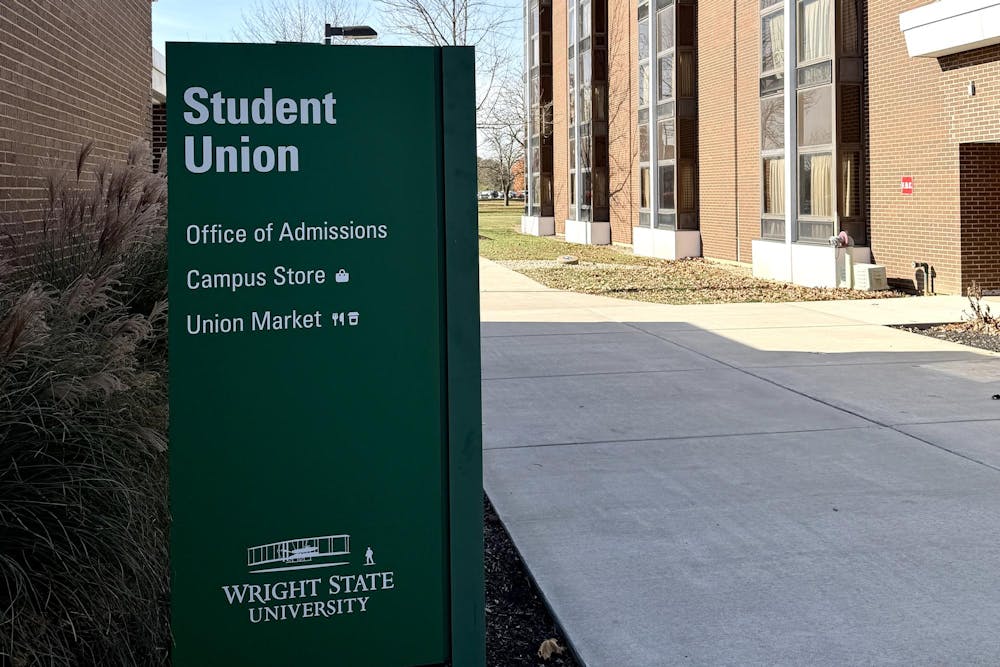
On Nov. 13, 2025, Wright State University’s Faculty Senate met in the Endeavour Room at the Student Union to discuss important matters relating to WSU. Some of these included enrollment data, talks of the addition of a General Studies Major and changes to the current curriculum.
Enrollment data
After the meeting was called and the minutes were approved, the Senate dove into reports. According to WSU Provost Jim Denniston, WSU’s saw a nine-point increase of first year students and continuing enrollment saw numbers of 5.9%. International Students, however, have decreased in enrollment by 19%.
According to FAFSA data provided by Provost Denniston, 49% of WSU students are Pell Grant recipients. Over 33% of students identified as first-generation college students, and 28% of students identified as an underrepresented minority.
Additionally, the numbers showed that Centerville was the top feeder school into the WSU population.
There will be changes to the evaluation process of tenure and curriculum changes. All Diversity, Equity and Inclusion related items were removed from the policy as of Sept. 25, 2025; however, the rest of these changes will not be implemented until June 30, 2026.
Dawn Wooley, President of Faculty Senate, maintained that the Senate is still committed to supporting faculty through this transitional period.
“The Faculty Senate remains committed to ensuring that faculty perspectives are represented in all discussions regarding policy interpretation and implementation. We are working with university leadership to maintain transparency and to uphold the principles of shared governance and academic integrity that define our community,” Wooley said.
Power outage concerns
The power outage resolution was also discussed. The resolution stated that WSU should send out an alert of emergency when there are power outages. This is following the loss of research materials during the June 2025 outage this past summer.
The WSU Police Department’s Chief of Police, Kurt Holden, raised concerns for the effectiveness of alerts if this is implemented.
“The WSU Alert system is intentionally reserved for incidents that present an immediate and credible threat to life and safety. Expanding its use beyond that scope could reduce its effectiveness and contribute to alert fatigue across the community. Based on the information available at the time, the situation did not meet that threshold,” Holden said. “Even so, the outage revealed opportunities to strengthen how we communicate during incidents that disrupt research or property. Public Safety, Environmental Health and Safety and Facilities are already reviewing lessons learned and are actively examining opportunities to improve protocols and response.”
WSUPD and the Faculty Senate are continuing to work on a solution for this resolution.
“We look forward to working collaboratively with university leadership on comprehensive reviews and improvements to emergency communication protocols to safeguard our community and assets moving forward,” Wooley said.
Lastly, there was a short discussion on the removal of programs that have low occupancy or simple curriculum modification. Some of these include the deactivation of three master's programs, being Mathematics, Elementary Education and Physical Education. There are also the modifications to the Bachelor of Chemistry.
There were some programs that were reported terminated. According to the document provided by the Senate, they have not been offered for years but had never officially been taken out of the course catalog.
General Studies BA
Also discussed at the meeting was the potential of a new bachelor program called "General Studies.” Provost Denniston held a question-and-answer session to discuss the nature of the degree.
This degree is not housed in one particular college. The General Studies bachelor includes one core class that is required as well as electives. The program is created for students who are very close to graduating and need to change their majors or had to drop suddenly.
The idea of a General Studies degree was a contested one as several Senators expressed concerns about the idea. Concerns about learning outcomes and freshmen opting in for the degree were raised. Provost Denniston maintained that things will continue the way they are meant to be done.
Change to Forensic Science Minor
Additionally, there were talks about the changes to the Forensic Science Minor. The changes proposed were the changing of science classes needed to complete the degree. These classes were proposed to be changed to better fit the needs of the program. According to the proposal, originally the minor required some higher-level courses to the minor that were generally unneeded.
“The Dean of [College of Science and Mathematics] suggested this change. The science section of the FS minor contained extremely difficult upper-level courses,” the proposal said.
As of now, these changes have not been approved by the Faculty Senate, but they were moved to old business to be voted on at the December meeting.
All of the committees gave their minutes and the meeting was adjourned.