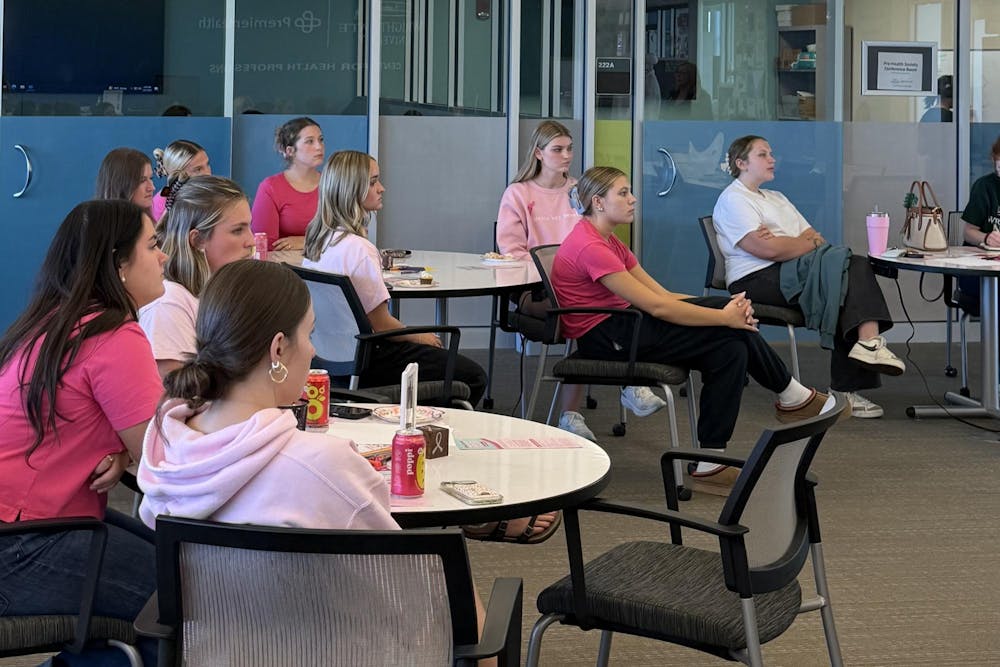
On Oct. 1, Wright State University’s chapter of the women’s-only fraternity, Zeta Tau Alpha, hosted an event spotlighting the importance of early diagnosis and treatment of breast cancer. With a focus on education, ZTA conveyed essential information that all people should know, especially during Breast Cancer Awareness Month.
ZTA’s event and philanthropy
When attendees entered, they were greeted by an ambiance of pink decorations, desserts and informational flyers. These were put on every table for attendees to read and take home with them.
Izabella Bell is a sophomore at WSU and serves as the philanthropy and service chair for ZTA. In this position, she has become well-versed in Breast Cancer Awareness. She was in charge of coordinating the event and shared about the behind-the-scenes aspects in an interview.
Bell worked far in advance to get all the guest speakers and supplies needed to host their event, including donations.
“I have had so much breast cancer in my family, so getting to see this event and getting to communicate that to college students who may not have ever had breast cancer in their family, so don't really know about it, [was important],” Bell said.
Bell stressed the importance of knowing and looking for warning signs. Even if it has not historically run in someone’s family, regardless of age or sex, checking for warning signs is vital.
“We're gonna write cards to oncology people at Premier Health. And we also have postcards for if you know that someone in your family has breast cancer or had breast cancer and they got over it, you can write [and] send them a postcard, and it's from Zeta's Foundation,” Bell said.
Becca Reuber is a senior at WSU and runs ZTA as the President of the chapter. In her speech welcoming attendees on behalf of her chapter, she spoke about the importance of the cause.
“Within our chapter, we are committed to shining a light on this cause over and over and over again, not just through October, but all year round,” Reuber said.
The chapter hosts events throughout the year, but October is its busiest month, especially with the upcoming volleyball tournament on Oct. 25.
“We are honored to welcome someone who truly embodies strength, resilience and inspiration. She leads our university with vision and heart, and as a breast cancer survivor herself, her story reminds us why this cause is so important to us,” Reuber said.
Naturally, such an introduction can only be about one woman.
President Sue speaks
WSU President Sue Edwards came to the event to speak on her personal experience with breast cancer.
“I was actually diagnosed with three cysts back in 2015 and, you know, you get busy. So, three cysts, I was like, well, they're benign. That's nothing. I won't worry about it. And then I got here to Dayton, and I was like, gee, I'm really uncomfortable,” Edwards explained.
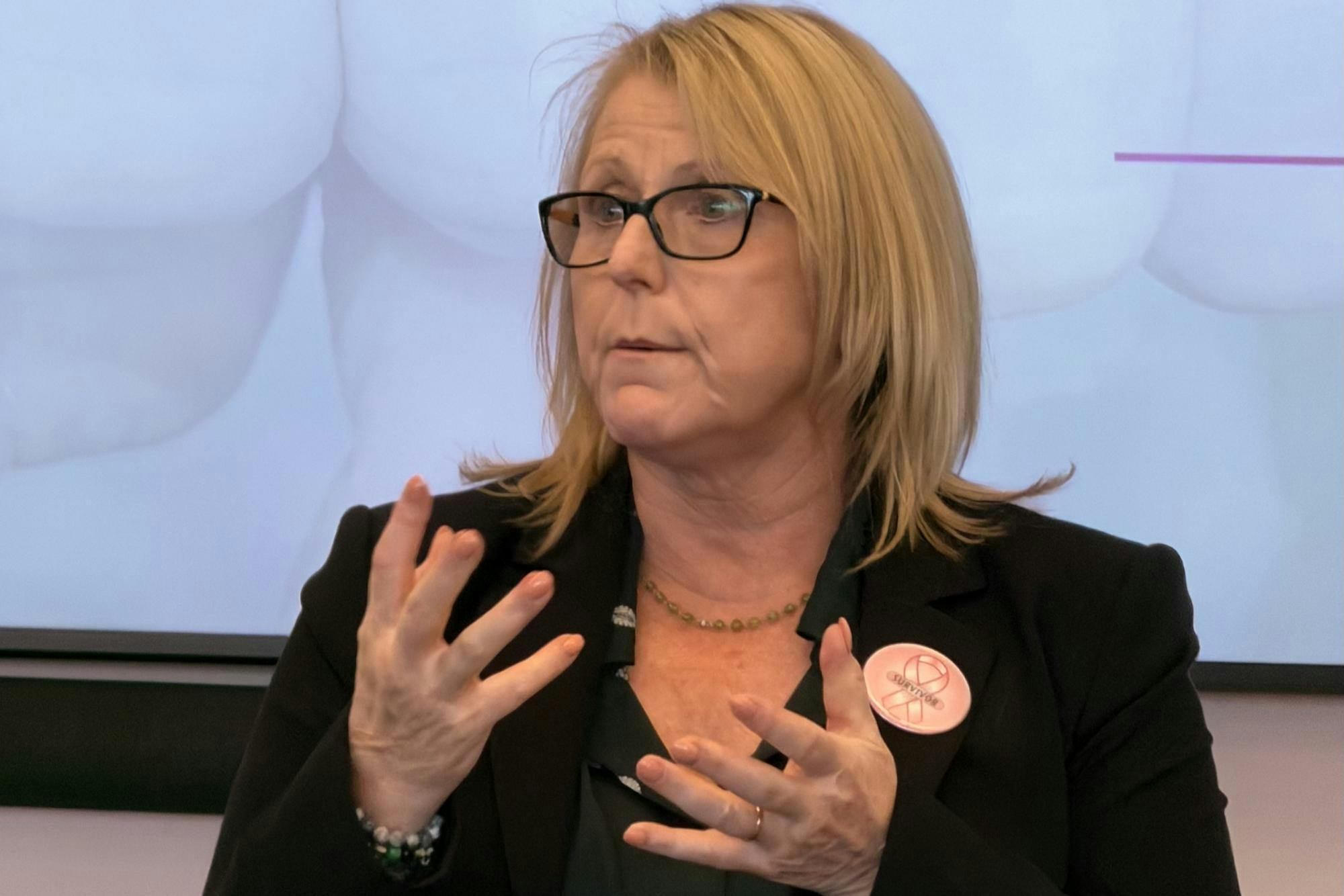
She described asking WSU’s medical school dean if they knew anyone who specialized in breast tissue and ended up going to see a surgeon the next day.
“I didn't follow up after being diagnosed with the three cysts. Consequently, I found out I had three tumors,” Edwards said.
Edwards described how her doctor viewed her cancer as a “really good one” because her tumors were all triple-positive, which is a subtype of breast cancer. This left Edwards with treatment options that would have desirable long-term results.
“I’ve got to have chemo, but I’d only just started here, so I had no sick time. And so, I made the decision then that I was just going to plug on through,” Edwards said.
She talked about her time walking around campus with hats, wigs or nothing at all, and says that students may see pictures from that time.
“It was so liberating,” Edwards said in reference to this era. “Because it takes a lot less time in the morning to get ready. And also, you're sending a message to other people, you know, do the homework, do the work. Don't be like me and ignore it and pay the price for it.”
This statement is the root of why events like this are important enough for busy individuals like President Edwards to come out to.
“Working was my way of coping with having cancer. The only time I took off was after my mastectomy, and that's because they wouldn't let me work. So, I'm not, I'm not a really good role model because I did everything wrong. Yeah, and that's why I'm a good role model for here; to tell you to do everything right, because the earlier you catch it, the better the outcomes. So, I wouldn't change anything, except I probably would have asked for a second opinion on those three cysts,” Edwards concluded.
Getting multiple opinions is important if a doctor says something is wrong. Edwards’ testimony about her time having breast cancer was powerful and sent the message of how important early identification and intervention are. One way to ensure early identification of any problems is to perform self-examinations.
Self-examination steps
One of the educational handouts provided by ZTA was a Kettering Health breast health sheet. It is waterproof– meaning it can be hung inside your shower, providing the self-check steps at a convenient time.
Kettering Health advises people to check at the same time each month; for example, at the end of a person’s period, and notify healthcare providers of any changes. It goes on to list the three steps to self-examination.
“Choose a bed or other flat surface to lie down on your back. When lying down, breast tissue spreads out, making it thinner and easier to feel,” the flyer reads.
This introduces the first step, which is “feel.” The flyer gives instructions for lying down, but it also discusses the shower, as this is where it is meant to be hung and stored. It instructs self-examiners to lather their hands and breasts before they perform the sub-steps.
“Use the pads of the three middle fingers on your left hand to check your right breast. Press using light, medium and firm pressure in a circle without lifting your fingers off the skin. Follow a circular or an up-and-down pattern,” Kettering Health explains. “Feel for changes in your breast, above and below your collarbone, and in your armpit. Repeat on your left breast using your right hand.”
The second step may involve a change of location, depending on where you performed the first step. It involves looking at one’s breasts in the mirror, looking for any changes. Similarly, this second step involves several sub-steps.
“Hold arms at your side; Hold arms over your head; Press your hands on your hips and tighten your chest muscles; Bend forward with your hands on your hips,” Kettering Health’s flyer reads.
Last but not least, the final step is to schedule an annual breast examination, or mammogram, with a doctor. If there are any changes, whether those are lumps, discharge or pain, healthcare providers should be notified immediately.
“Breast cancer affects one in eight women, and it's time to make that none in eight,” Reuber said.
The first step to achieving ZTA’s goal of none in eight, everyone must be aware of the warning signs and know how to perform self-examinations like these. Education is crucial, especially during Breast Cancer Awareness month.