
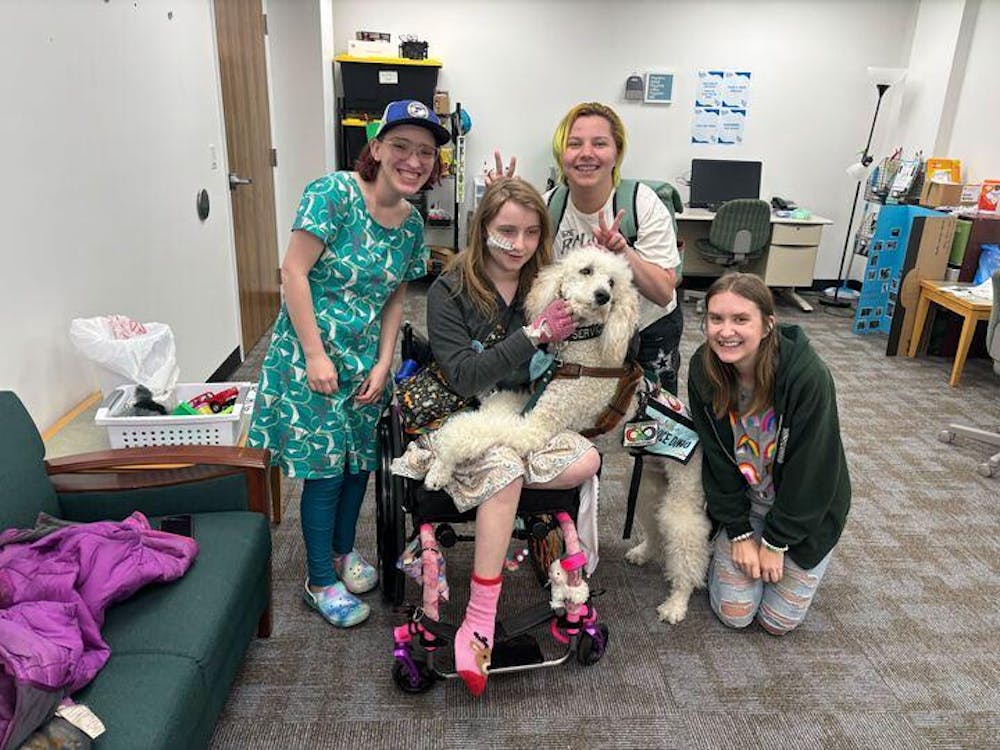
Wright State University is home to a diverse student population. As the third-ranked university in the nation for disability accessibility, it is easy to assume that students could expect a fully inclusive space at WSU. However, some students do not feel this way, especially those with invisible disabilities. To raise awareness for neurodivergence, a group of such students approached the Guardian with their experiences as Raiders.
What is neurodivergence?
Many things can qualify as neurodivergences, with the most commonly known being attention deficit hyperactivity disorder, or ADHD, and autism spectrum disorder. However, many other things qualify as neurodivergence. Some of these include dyslexia, certain types of depression or anxiety, post-traumatic stress disorder, obsessive-compulsive disorder and more. Often, a neurodivergent individual will have multiple of these diagnoses or suspect other additional ones.
To get the best understanding of what it feels like to be a neurodivergent student, it is essential to ask multiple students with varying identities about their daily life and how they feel about what others qualify as disorders.
Olivia Hurley is a first-year student at WSU, majoring in psychology. Hurley is an advocate for both visible and invisible disabilities, including neurodivergence. She is open about her own experiences, including her diagnosis with autism and other neurodivergences like panic disorder and PTSD.
"There [is] a lack of education and a lack of training to include neurodivergent individuals in the conversation, but also a lack of understanding that's not like we're not trying to get, you know, something extra or something special, we're trying to get what we need to level a place playing field, or be okay with something," Hurley said.
She described how she and others may feel anxiety when they are in a situation where they wish to help but feel unsure of what actions to take. Having detailed knowledge of expectations can be incredibly helpful for times like this.
Charlotte Mountz is a psychology major who just completed her first year of college at WSU. Mountz is diagnosed with autism and is an advocate for disabilities.
"Our brains can't fill in information the same way that neurotypical people might be able to, but at least it would seem, based on the lack of information some people sometimes give me, I would guess neurotypicals can fill in. I'm not a neurotypical, so I don't know their brains, but I would guess they can typically fill in more information, because of the lack of information we're given sometimes," Mountz said.
Anthony Johnson is a freshman computer science major at WSU. He is diagnosed with depression, anxiety and ADHD, and shared what his experience feels like using an analogy.
"Everyone has to go around carrying marbles, and every time you have a thought, you add a marble. And every time someone tells you something. You add a marble, and everyone else has a nice, like velvet dice bag, and yours is a mesh bag that looks like a pair of fishnet stockings. And every time you add a marble, three more marbles fall out, and there goes your thoughts and your energy and what everyone else just said, and you have to walk around carrying these marbles, trying to keep them in and trying to hold on to them while everyone else is having a grand old time," Johnson said.
"If everyone would just help you pick up your marbles, sometimes it would make your life easier, and you wouldn't have to worry about going and chasing your marbles all the time."
This analogy ended up carrying through the conversation, and when comparing neurodivergent life to that of a neurotypical, Johnson said, "You don't have to go around chasing your marbles. We have to go around chasing our marbles all the time, and it's very tiring."
How to support them
Neurodivergent people are everywhere, and they all have different needs for what kinds of support or resources would be helpful for them. All people must receive any support they require to be successful.
"I think a lot of neurodivergent people are made to feel like they're lazy or whatever, because they're just saying they're doing nothing, but like we want to help, but we can't make our brains know what to do in the same way," Mountz said.
Some neurodivergent people will struggle with executive dysfunction when they are unsure of what steps to take first, and this will result in the person freezing up and not doing anything until the thought pattern is broken. Sometimes, this can be misinterpreted by others as laziness or even childlike behavior, but it is neither.
"Then not treating us also like the capable human beings we are, like, treating us like we're kids with one, not like kids with no autonomy, like not giving us the autonomy that we are capable of having and deserve to have, just like any other person," Mountz said.
Understanding that some people's minds work differently is essential to working on any team, whether members are neurodivergent or not. Having good resources for communication and expectations in place could be beneficial to some individuals in this way, as was pointed out by Johnson.
"What goes through a normal, like, neurotypical person's head would be like, Oh, streamers. Put the streamers on the door. But for us, it's like, what do we do? Do we put the streamers on the door? Do we put it on the wall? Do we put it on a table? Where do the streamers go? Are the streamers for guests, or are they for us to put up? What happens with the streamers? And then we just sit there and we wait until someone's like, 'Hey, can you put the streamers on the door?' And that's all it takes," Johnson said.
"If they would genuinely take like, two minutes to write out a Google Doc of things that need to be done and be like, 'Okay, here's a list of things that need to be done,' then more neurodivergent people would be able to go and go, 'Oh, well, the streamers need to put on the doors. And nobody's putting the streamers on the doors, so I'll grab the streamers and put them on the doors.' It wouldn't be much sweat off the neurotypical's back."
It is essential to treat all people with empathy and understand that each person is unique, and may have a different communication style, but that does not mean they deserve less kindness or independence than the next person.
While many small things can be done to make neurodivergent people feel more included and seen, the main thing is seeking education. Most individuals with unique needs will be open and honest about what they need and why, so asking questions is always a good option.
Additionally, all students should seek to learn how to interact with neurodivergent people most effectively, because it should not all be on one person, especially if they already have other things to worry about, such as chasing down their marbles.


