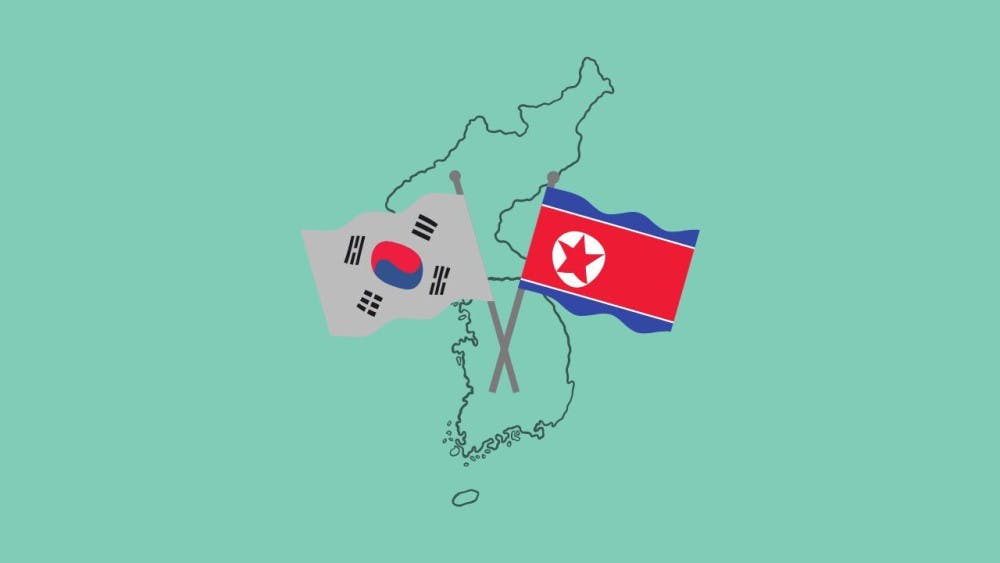
North Korea V. South Korea | Graphic by Bethany Althauser | The Wright State Guardian
With North Korea ramping up military provocations and aligning more closely with Russia, tensions on the Korean Peninsula have escalated, leaving South Korea on high alert and raising questions about potential U.S. involvement in a renewed conflict.
The history between the Koreas
For centuriesKorea was unified under generations of dynastic kingdoms. They were annexed by Japan in 1910 and remained this way up until the end of World War II. In 1945, the Soviet Union and the United States decided to split Korea as a means to dismantle the Japanese Empire.
Soviet ideals were popular amongst North Korea where many laborers and peasant populations lived. South of the 38 parallel, the middle class supported the U.S.anti-communist regime.
The idea was for the Koreans to figure it out amongst themselves. That did not end up happening, which led to the Korean War.
The Korean war did not end up fixing the issue and made the U.S. enemies to North Korea. After the war, the two sides stayed separated and formed different governmental rules.
South Korea mimicked their American allies, and the North modeled their government after the Soviet Union.
Today, the tension has grown, and South Korean officials are nervous of the chance of another war.
Today
Recent weapons tests by North Korea, including the development of long-range missiles and potential nuclear capabilities, have heightened tensions on the Korean Peninsula.
These actions have left South Korea increasingly anxious about the possibility of further provocations. In response, South Korea has mobilized troops and bolstered its defensive posture near the border
On Oct. 11, North Korea accused South Korea of flying drones with propaganda into their capital, according to the BBC. After which, Kim Jong Un, Supreme Leader of North Korea, met with his military cabinet and began to bomb roads that connect the Koreas.
This caused South Korea to be put in a state of emergency around Seoul and to ask that no one send anymore leaflets to North Korea.
It is currently unclear if the Koreas will go to war again. If that is the case, what can Americans expect from the war?
U.S. involvement
The U.S. seems to be more concerned with the relationship North Korea has with Russia.
Russia and Ukraine have been at war since 2014, with major traction happening in 2021. According to the United States Department of Defense, there is reason to believe that North Korea is sending troops to Russia to aid in the war.
“Evidence suggests that North Korea has sent approximately 10,000 troops to Russia. Some of these soldiers have already moved closer to Ukraine and they're being outfitted with Russian uniforms and equipment,” Secretary of Defense Lloyd J. Austin III said in a Press Conference about the subject.
With this partnership, Austin vows to keep the relationship with South Korea and the U.S. strong.
“I assured Mr. Kim today that the United States remains fully committed to the defense of the [Republic of Korea], Our extended deterrence commitment remains ironclad. That commitment is backed by the full range of America's conventional, missile defense, nuclear and advanced non-nuclear capabilities,” Austin said.
Student opinion
Students at Wright State University have very mixed opinions on the situation. There are a few students who are sympathetic to the cause, like marketing major Hannah Layton.
“I think that we should help them,” Layton said, “especially if Russia is helping North Korea. They will get bodied and that isn’t fair to the innocent people in South Korea.”
There are other students like former student Donny Mrowiec, who thinks that the U.S. and Russia should stay out of it.
“This is exactly how the Korean War happened, everyone else got involved and a bunch of people died. Let them work it out on their own. We have too many problems here to worry about Korea anyway,” Mrowiec said.
No matter what students think, it is clear that this is a hot button issue that could be affecting us soon.