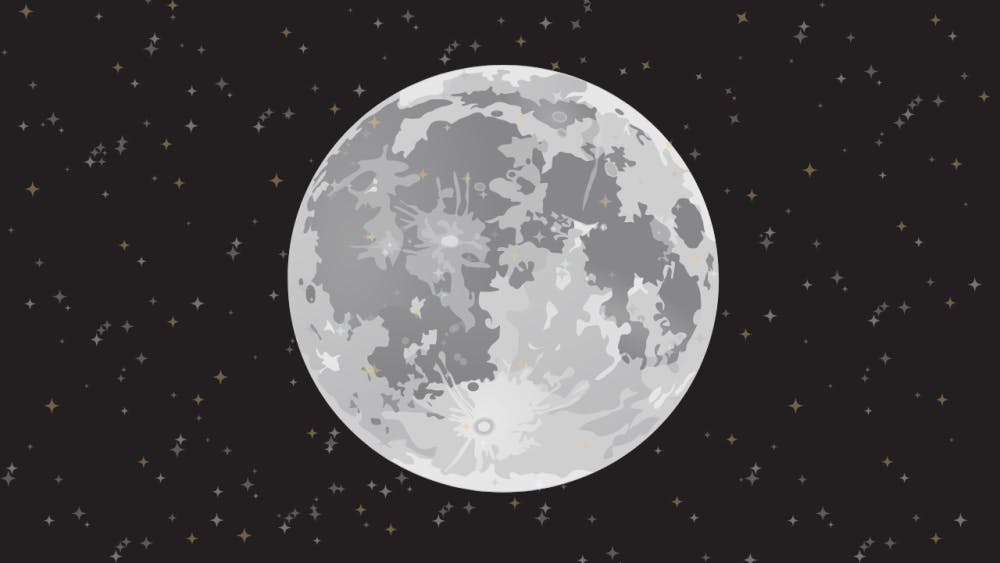
Symbolism of the Moon | Graphic by Rose Taylor| The Wright State Guardian
For years, the moon has been used as a symbol in music and art. The interpretations have changed based on the person and the time period, but they continue to be used.
The art of the past
Artists have been incorporating the moon into their work for hundreds of years. One artist in particular, Francisco Goya, used the moon as a symbol of darkness in his work, dating back to 1789.
In multiple of his paintings, Goya added the moon to shine light on the darker themes of the rest of the painting. This can be seen in his artwork “Witches’ Sabbath” as the moon illuminates the sacrifice that is taking place in the painting.
Another artist, Caspar David Friedrich, follows the same themes of using the moon to convey a message of mystery and horror through his artwork in 1819.
Friedrich’s most famous painting, “Man and Woman Contemplating the Moon,” shows a man and woman standing in a dark forest, and the only light they have comes from the moon.
Art is subjective and people can draw different meanings from the same painting. However, in the 18th and 19th centuries, it was heavily believed that the moon was a symbol of darkness and evil.
Adam Heardman, a poet and writer, discussed how the moon used to be viewed by the public in one of his articles.
“Broadly speaking, until the most recent stages of human history, the moon was an inherent symbol of darkness, danger and, in the quiet oblivion of sleep, an intimation of humanity,” Heardman said.
Referencing the moon in music
Looking at art and music in the 21st century, there is a large tonal shift in how people view the moon. Whereas in the past the moon meant darkness, today many artists use the moon to paint a picture of sadness and love.
One example of this can be seen from Bruno Mars in his song Talking to the Moon. He uses his lyrics to tell the story of how he had been in love and wished he could have her back.
“Every night I’m talking to the moon, trying to get to you, in hopes you’re on the other side talking to me too. Or am I a fool who sits alone talking to the moon?” Mars wrote.
In this song, he used the moon as a symbol of his love, trying to use the moon to reach back out to the woman he loved but could not have.
Another example of this can be seen in Moon Song by Phoebe Bridgers. In her song, she writes about having unrequited feelings for someone and wanting to give them everything.
“And if I could give you the moon, I would give you the moon,” Bridgers wrote.
The moon is viewed as the biggest symbol of love in this song. She wants to show someone how much she loves them, but she is unable to, just as it is not possible to give someone the moon.
Growing up and changing perspectives
As children, there are some books that most kids have read, or have read to them. A very well-known children’s book is Goodnight Moon.
In this story, a child is being tucked in for bed. The author writes that many household appliances, pets, and more say goodnight to the child. As the story continues, the reader can see the moon through the window in the bedroom, as it is referenced many times.
Kayla Davenport, a student at Wright State University, has done research on symbolism through art and literature to analyze pieces like this.
“In children’s books, such as Goodnight Moon, I believe the moon is often portrayed as a maternal figure,” Davenport said.
In the 21st century, the moon is seen as a loving figure. For children, this tends to be maternal. As people get older, they start to see the moon as a friend or confidant.
Interpretations of symbolism have changed drastically through the years. Even today, people have their own opinions of what things represent. That is part of the beauty of art, it is subjective to each person.