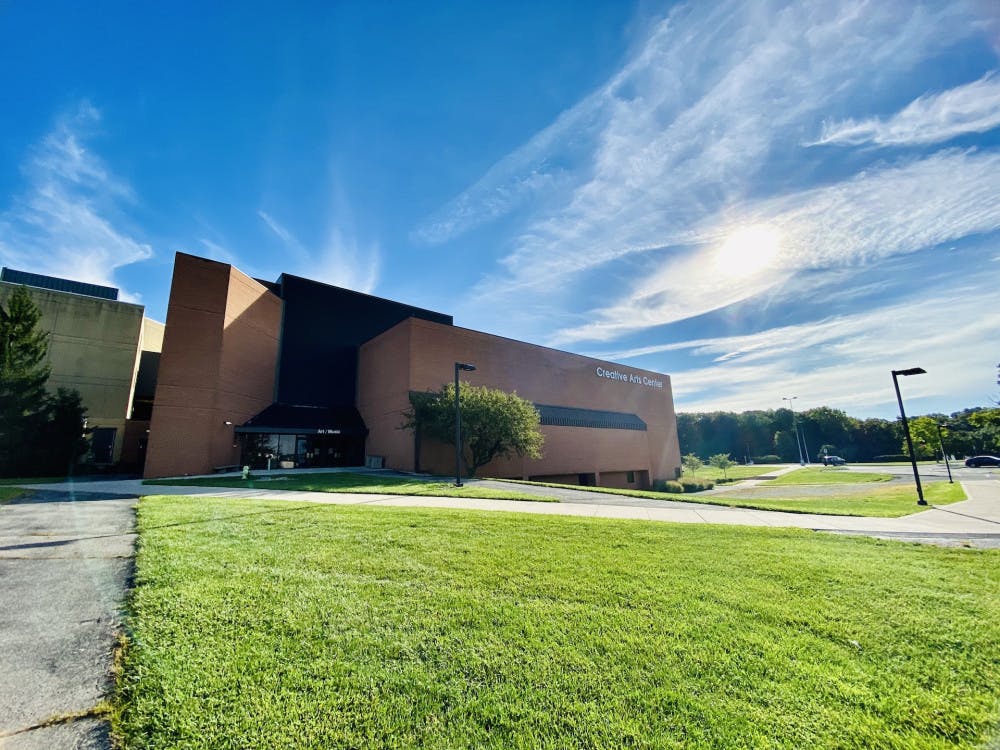
Creative Arts Center | Photo by Kayli Thompson | The Wright State Guardian
This fall semester, courses at Wright State University’s (WSU) School of Music will operate differently than normal.
Due to the pandemic, the department is not able to host classes in-person for all of their students, and an update from the chair of the School of Music, Dr. Daniel Zehringer, has been posted to their website to help clear some of the confusion.
“The majority of our lecture courses will be done remotely, and most of them will be done synchronously,” Zehringer said. “A few of them will be done asynchronously. The majority of the large courses, because we can’t have too many students in a safe manner in one space, those spaces are being offered remotely.”
Many of the department’s courses will still have in-person components.
Choral ensembles
Three of the choral ensembles at the university will be meeting during this semester: Collegiate, Men’s, and Women’s Chorales. Collegiate Chorale, an upper-level ensemble, will be taught fully remotely this semester, and the Men’s and Women's Chorales will be meeting at specified times split into their sections.
“That will allow them to meet in our large spaces and still be able to sing with masks on and be able to be safe,” Zehringer said. Meetings for these courses have been moved to the largest performance spaces in the School of Music in order to properly comply with social distancing.
A fourth choir at WSU, University Chorus (a co-ed ensemble), is not available this semester due to the amount of people who would be singing together.
Orchestras and Bands
Both the chamber and symphony orchestras will be meeting face-to-face during the fall semester. However, these orchestras will consist of only string instruments.
Those who play string instruments in the orchestras can wear their masks while they are playing. A small number of percussionists can participate if they are needed. The Percussion Studio will still have its ensemble meeting regularly, though smaller groups will be attending these sessions.
The concert and wind symphony bands will be taught using very few face-to-face meetings, while the pep band will meet in person.
Concerts
Currently, indoor music concerts cannot be held with an audience, and no performances have been scheduled for the ensembles. However, juries, as well as the recitals for junior, senior and graduate students, are crucial for a music major’s education, so these will still occur near the end of the semester.
Recitals are being held with only the performer, accompanist and whoever else is involved in the performance space. These concerts will be live streamed, likely over Facebook Live, and recorded.
“I think that may get our students and faculty who are doing performances out into the community in greater numbers than if we were doing live performances,” Zehringer said.
Lessons
The ensembles at WSU are not the only important aspect of a music student’s education.
“The biggest component of our teaching here is actually applied lessons, which would be one-on-one lessons with one teacher and one student,” Zehringer explained.
Students involved are choosing the in-person and remote options, though remote lessons do present a problem.
“The platforms that are available aren’t necessarily advanced enough to make the experience as good as being face-to-face. It’s a little more challenging when you’re playing an instrument.”
Zoom and WebEx are being utilized for these virtual lessons as well as two newer programs that are audio-only.
Spring semester compared to fall
Switching from in-person to remote classes during the spring semester was difficult for the School of Music.
“Teaching an instrument, anything that is acoustic, is best taught together in the same room,” Zehringer stated. “The size of the room matters, getting that instant feedback and the delicate nuances that only live instruction can give. Those were all taken away from us.”
Many of the professors in the department, for the first time, had to use video chat software in order to teach their lessons, which caused difficulties.
Once students returned to school for the fall semester, they were given the option to take their lessons either face-to-face or remotely.
“The biggest challenge is being able to give our students the same or the best experience we can while being limited with the dimensionality of these platforms,” Zehringer said.
However, both Zehringer and Dr. Shelley Jagow see upsides to teaching their courses virtually.
“Now that we have this time because we don’t have a performance looming over our head, we can take a little more time and delve into some of these concepts in greater detail and make sure that we’re really understanding it,” Jagow said. “Then, they’ll come out of it with some enhanced skills that we can hopefully apply to our large ensemble rehearsals and performances when we get back to normal.”