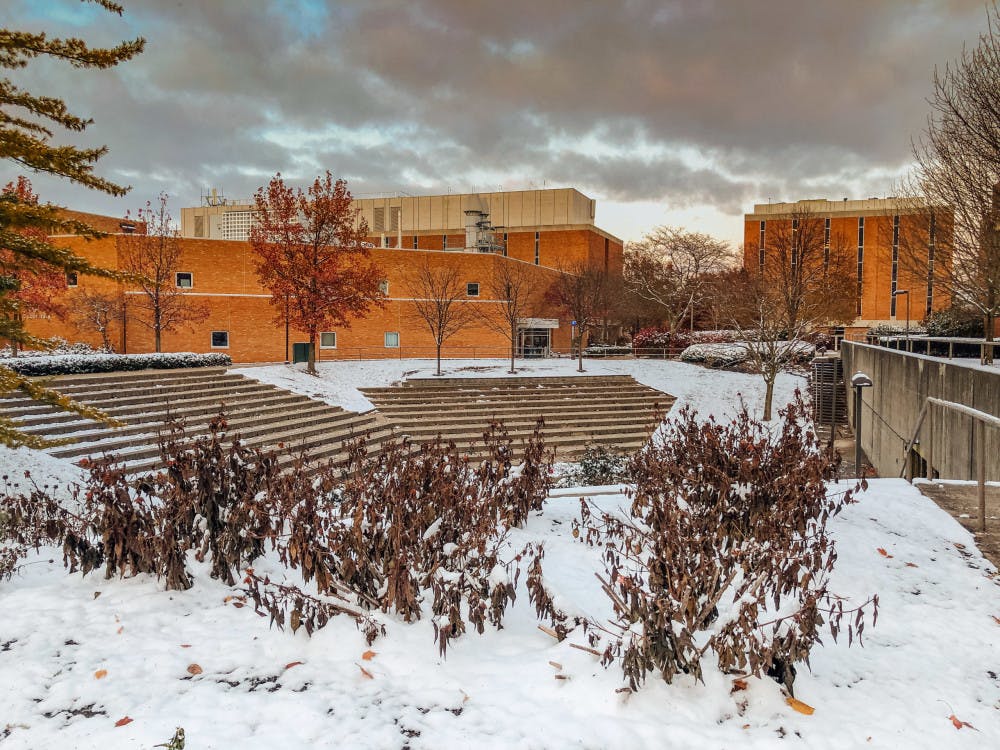
Wright State campus after first snowfall of the season | Photograph by Soham Parikh | The Wright State Guardian
It’s not just a coincidence that one’s mood might decline at the sign of winter. Seasonal affective disorder (SAD) is a common disorder during the colder months.
“It is depressive symptoms that don’t meet the criteria for major depression usually. It occurs because of the change in seasons. It’s fairly regular as time changes and the earth rotates on its axis,” said Dr. Tara Hill, director of the School Counseling Program.
As the temperature drops and amount of daylight dwindles, some may be affected more drastically than others.
“We lose sunlight and we’re inside more because of the weather so we don’t get as much vitamin D and other things our bodies need to maintain an elevated mood,” said Hill.
The symptoms of SAD include:
Fatigue, depressed mood, loss of interest, irritability, changes in sleep habits and eating habits, and pessimism.
“I get really lethargic and don’t want to do anything but stay in my house and sleep,” said Wright State senior Alicia Collins.
Collins previously lived in Huntington Beach, California. The weather stayed consistent in California and therefore there wasn’t an opportunity for deficiency from the sun.
“I did experience nostalgia. Winters in California made me feel like I missed fall and winter in Ohio, but now that I’m back I realize that I actually don’t,” said Collins.
“Almost everyone is deficient in vitamin D,” said Collins. “I think they should offer it on campus, vitamin D deficiencies are directly linked to poor mental health.”
According to the Diagnostic and Statistical Manual of Mental Disorders, or DSM-5, there is a specifier under depression that is a seasonal pattern, consisting of major depressive episodes usually in the fall and winter. It has to occur over two years to be considered a specifier.
“You have to push yourself even if you don’t feel like it because depression will tell us to just stay home,” said Hill.
According to Hill, 10 to 15 percent of the American population has a mental health disorder.
“College students are more susceptible to depression anyway because of other circumstances. Being on your own or away from family, having a chaotic schedule, students are susceptible to situational depression,” said Hill. “The typical onset of depression is between 18 to 24 years old.”
There are different ways to combat feeling SAD. Being conscious of the amount of light exposure one gets during the winter months is the first place to start, according to Hill.
Due to the shorter onset of the disorder, Hill does not recommend starting anti-depressant medication because of SAD. The effects of SAD are prevalent, on average, for about four months. Anti-depressants take six-to-eight weeks to take effect.
“You want to do outside activities and expose your skin to light,” said Hill. “Doing some of these naturalistic, holistic things like exposing yourself to light and taking vitamin D, seeking help and getting counseling is going to be key,” said Hill.